MACS: Modular Activated Cancer Suppressor
Single-mRNA-Encoded Multi-Domain Protein System with Acidic Microenvironment-Responsive Logic Gating
Selman Ali Dokumacı
Independent Computational Biophysics Project | 2026
The Selectivity Barrier in Solid Oncology
Highly potent modalities (ADCs, T-cell engagers, cytokine fusions) often fail due to severe dose-limiting toxicities in normal organs expressing baseline target levels. Single-target constitutively active biologics are vulnerable to target downregulation, antigen loss, and stromal barriers in NSCLC and PDAC.
MACS addresses this by ensuring the biotherapeutic remains shielded in healthy circulation (pH 7.4) and activates selectively within the acidic tumor milieu (pH <= 6.8).
System Architecture
Chain Definition
947 amino acids encoded sequentially.
Module A (1-587)
Effector and structural scaffold components.
Module B (588-947)
pH-responsive shielding module.
Translational Advantage
Single mRNA construct delivery potential.
Design Hypothesis & Scope
The architecture leverages specific domain pairings designed to conditionally occlude functional interfaces.
Note: While designed as a generalized platform, computational validation currently applies only to the specific prototype construct modeled here. Broad modularity remains a design hypothesis requiring diverse empirical testing.
Mechanistic Hypothesis: Acidosis-Driven Quaternary Gating
pH 7.4 — Proposed quiescent state
Histidine residues neutral (HIE). Intermodular latch disengaged. Module B flexible, extended. Effector interface proposed to remain shielded.
pH 6.8 — Proposed activated state
Protonation of calibrated histidine clusters (HIP). Module B compaction (+29.5 internal contacts). Candidate unmasking of effector binding register.
The simulations support a distributed, multiresidue pH-response model rather than a single-residue mechanism. Strongest convergence: B293 alternative microenvironments, B324 pKa-coupled remodeling.
Computational Evidence Stack
Conformational & MD
- All-Atom MD via GROMACS 2026.1
- 300 ns per pH condition (600 ns cumulative)
- Fixed-protonation approximation (specific residues modeled)
- Conformational descriptors
- Contact topology
Dynamics & Networks
- Elastic Network Models (ANM/GNM)
- 20-mode mobility profiles
- Dynamic Cross-Correlation Matrices (DCCM) with Louvain clustering
- Network analysis
- Sensor exposure mapping
Energetics & Titration
- Ensemble PROPKA 3.4 (101-frame ensembles)
- PB-MMPBSA: 1001-frame endpoint binding energy
Key Structural Findings
Module B Compaction
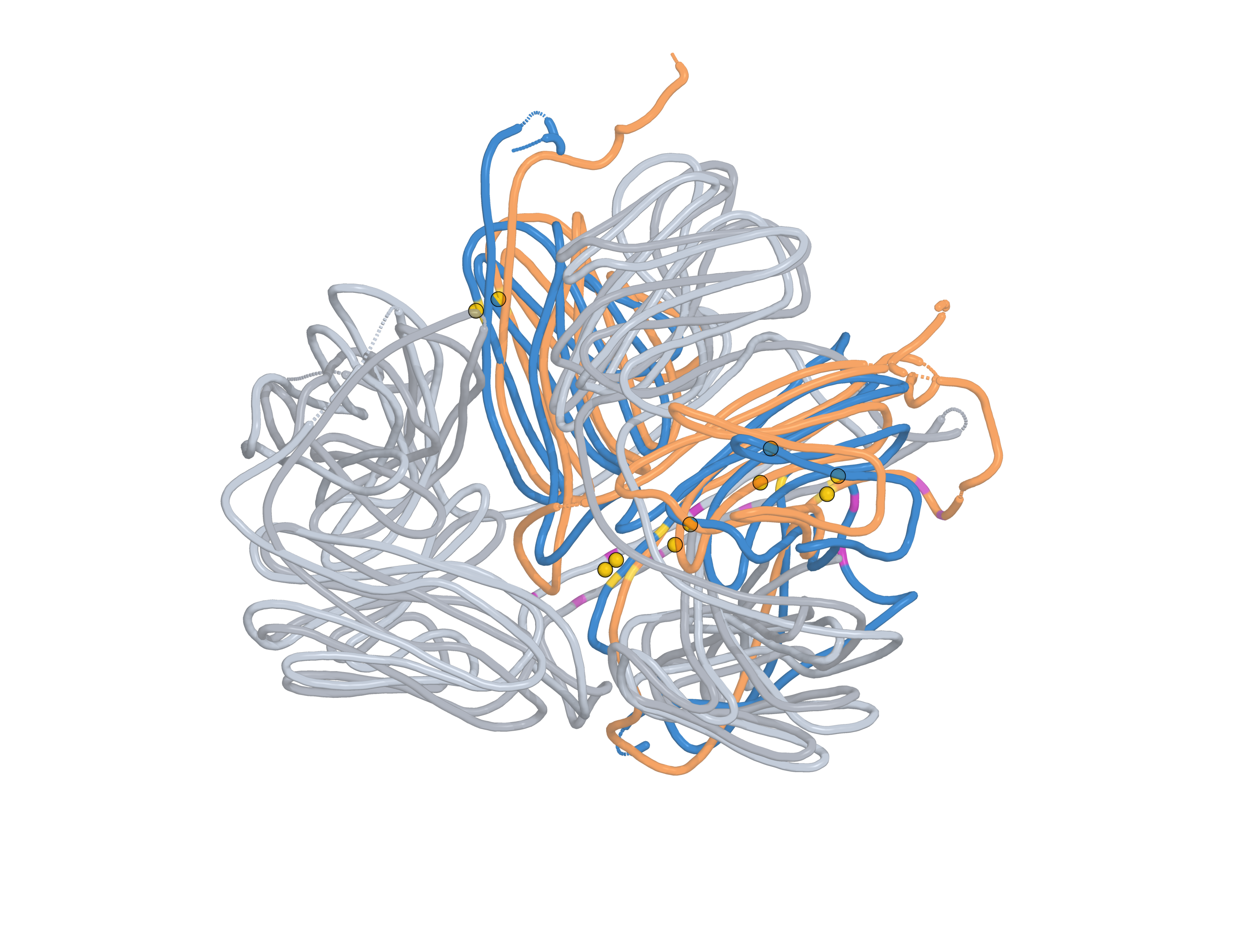
Trajectory-averaged conformations (pH 6.8 Module A light blue, Module B blue; pH 7.4 Module A dark gray, Module B orange; histidines purple, hotspots yellow)
| Metric | pH 6.8 | pH 7.4 | Observation |
|---|---|---|---|
| Internal Contacts | 778.09 ± 13.89 | 748.63 ± 14.51 | +29.46 contacts |
| Ca Rg (nm) | 2.6284 ± 0.0159 | 2.6481 ± 0.0186 | Slight contraction |
| Asphericity (nm²) | 1.4226 ± 0.0717 | 1.6061 ± 0.1141 | More spherical at pH 6.8 |
| Kappa-squared | 0.0989 ± 0.0035 | 0.0625 ± 0.0070 | Anisotropy change |
Source: moduleB_full_vs_last100ns.tsv (Data from Module B, last 100 ns)
Visual Evidence
Simulation Gallery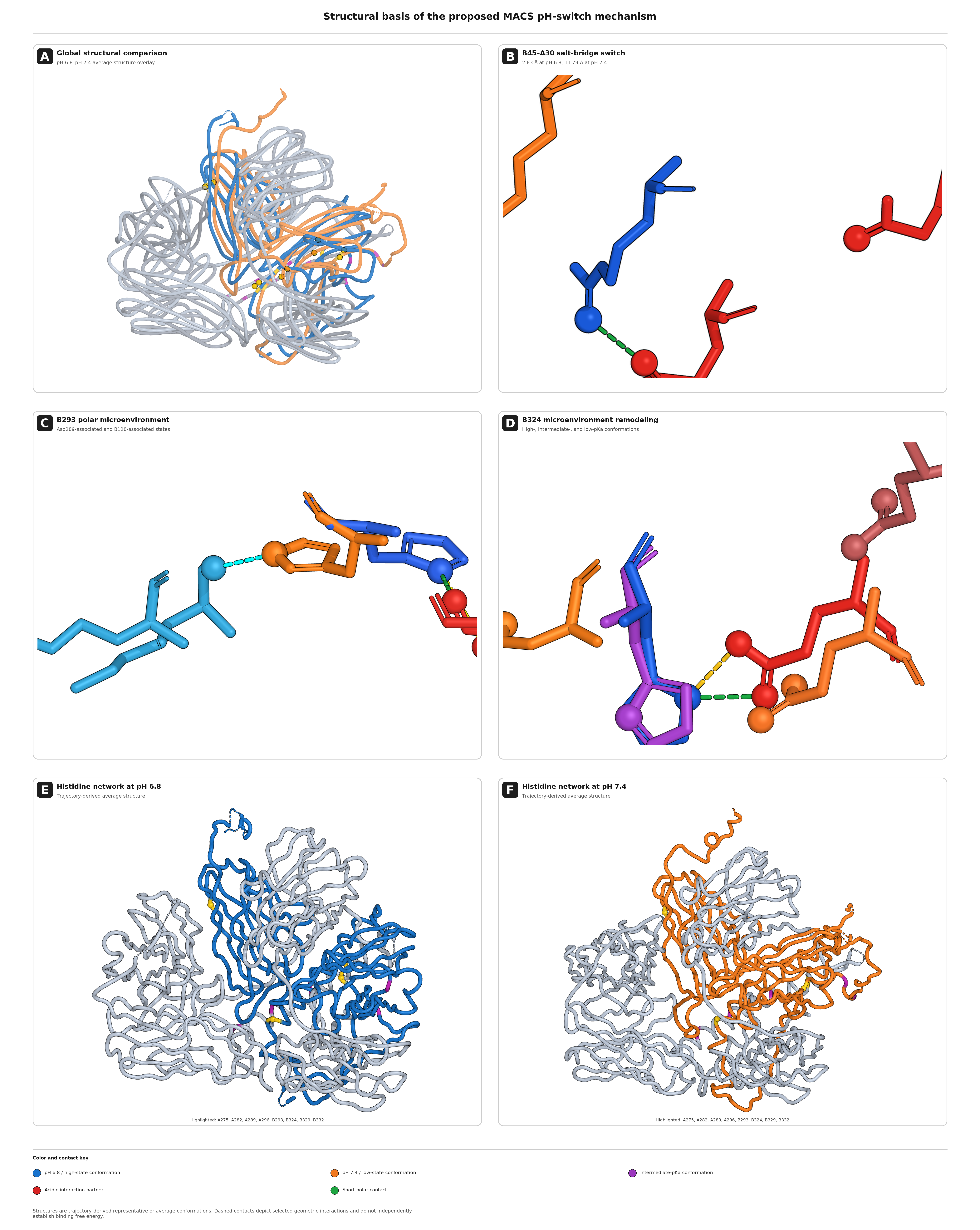
Conceptual Overview
Integrated mechanism overview: six-panel visualization combining global structural comparison, candidate residue microenvironments (B293, B324), and histidine network context.
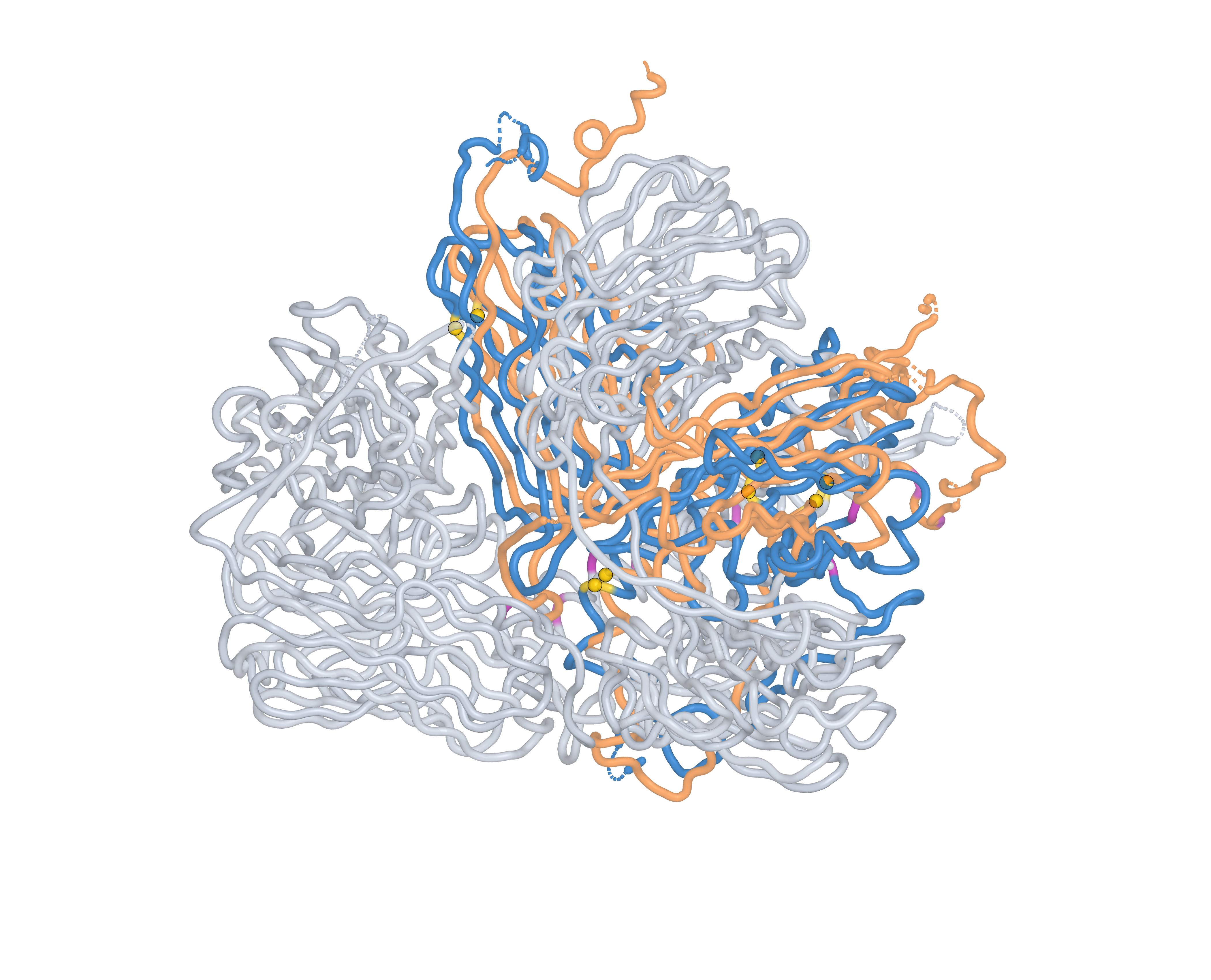
Protonation Topology
Histidine network overlay showing pH-dependent reorganization of protonation-sensitive residue clusters.
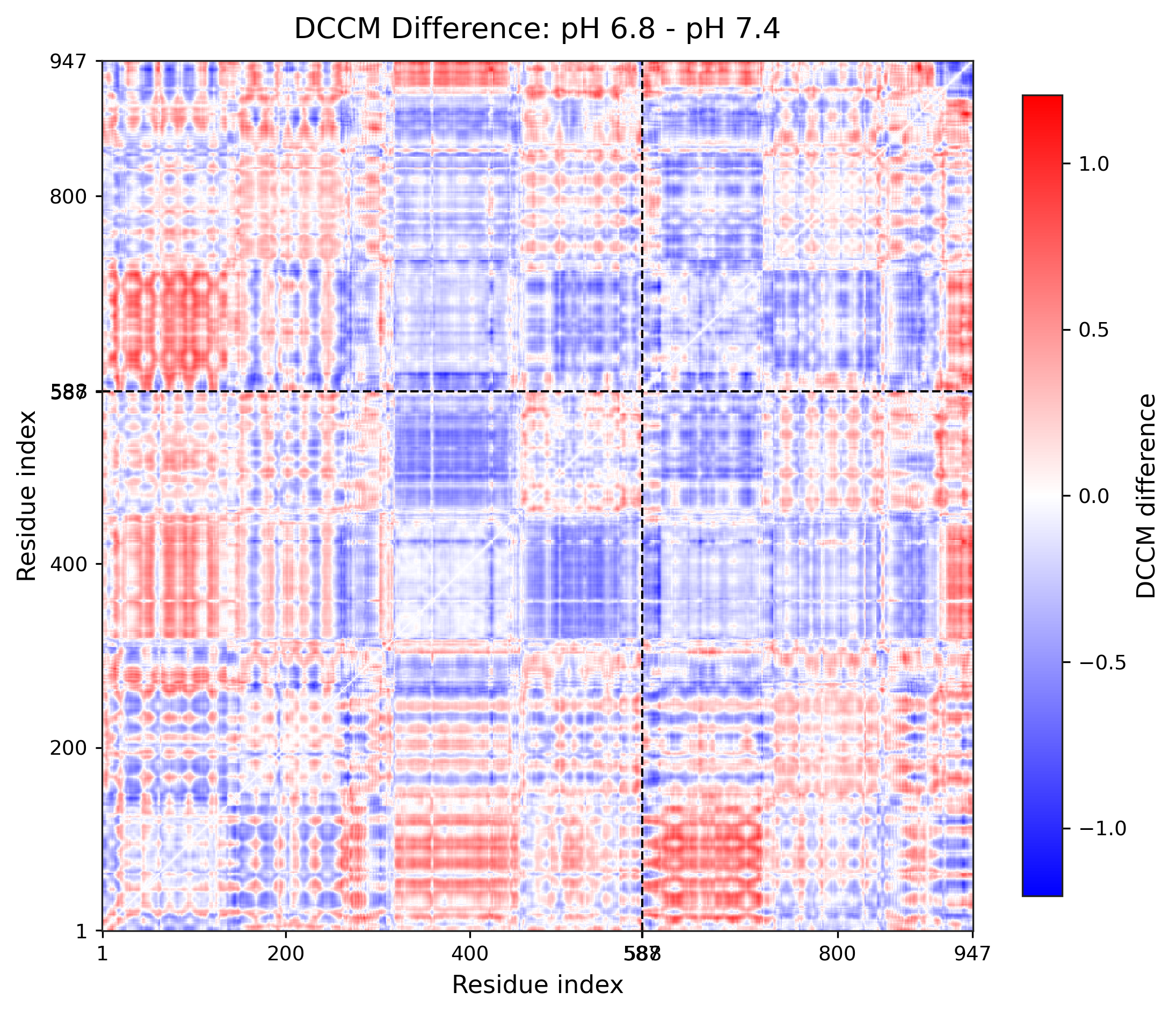
Allosteric Relay
Dynamic cross-correlation difference map (pH 6.8 minus pH 7.4). Reveals condition-dependent changes in residue-residue correlated motion.
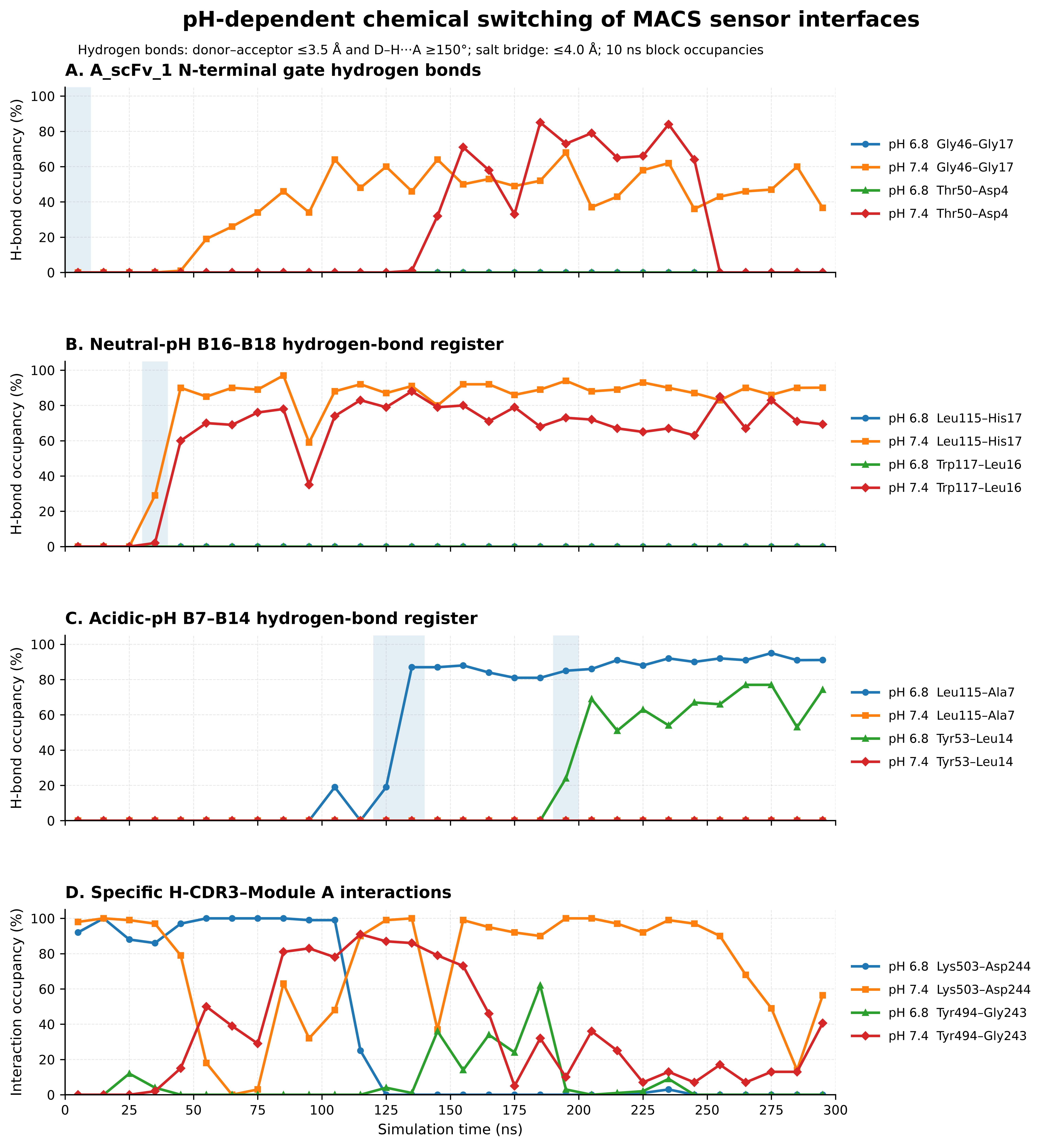
Conformational Register
Key chemical switch residues: time-resolved analysis of sensor exposure and conformational register across the full 300 ns trajectory.
Limitations & Planned Validation
Current Limitations
- Most analyses originate from one 300 ns trajectory per pH condition
- Fixed-protonation classical MD approximates pH effects through assigned protonation states
- PROPKA is an empirical structure-based estimator, not constant-pH MD
- ANM is a coarse-grained normal-mode approach
- PB-MMPBSA excludes configurational entropy
- No experimental validation exists in the current dataset
Next Steps
- Planned independent MD replicas: 4 per condition (8 total; 2.4–4.8 μs cumulative)
- Construct synthesis and expression in HEK293 / E. coli
- pH-dependent CD spectroscopy (folding stability)
- SPR/BLI binding kinetics (pH 6.8 vs 7.4)
- Selectivity in spheroid models (NSCLC & PDAC)
Important Note on Scope
The following claims are NOT supported by current data: that the pH-switch is experimentally proven; that a single histidine controls the entire mechanism; that Module B completely closes at pH 6.8; that PB-MMPBSA difference constitutes replicate-level statistical proof.
Research Documentation
Technical documentation, evidence summaries, and methodological records supporting the MACS computational research program.